The restaurant’s owner examines the sales and then at the bottom line before closing the report.
Does this sound familiar?
The report may be totally accurate, but if those are the only two figures reviewed, most of its value is being ignored.
It shouldn’t cause them to become more dependent on an accounting firm. It should provide them with confidence in their own financials. You don’t have to know each accounting rule, or do a lot of work in the evenings completing invoices. It’s crucial to understand why the profit changed and what transpired with the use of labor and food and what questions require attention next week.
Bookkeeping Chef’s ethos is to automate bookkeeping chores that don’t require the time of restaurant owners, while providing customers with more precise financial information they can utilize.
It is recommended to begin by looking at the Weekly Numbers and not just month-end numbers.
Although restaurants do not operate according to a calendar, they are still required to maintain an P&L. This week, the managers plan their activities. Chefs ordered food this morning. Vendors change prices now.
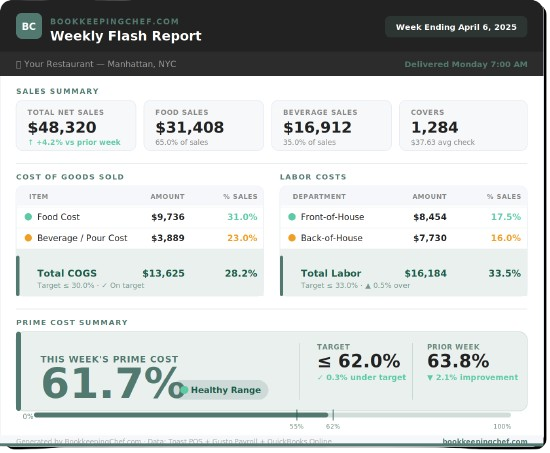
Bookkeeping Chef offers weekly flash reports on top costs along with monthly financial statements.
The prime cost comprises two key areas which can be quickly transported in a restaurant establishment: cost of goods sold, and the cost of labor. The information provided by the Bookkeeping chef indicates that prime costs usually represent 60% of sales in restaurants.
Suppose sales have barely changed, but prime cost rises. This alone won’t be the solution. It provides the person with a reason to investigate.
Did hourly labor increase? Did overtime occur? The cost of food changed? The invoice from the vendor seemed oddly large? Are there any changes in the sales mix?
It is much better to discover the issue earlier rather than later.
Automate the repetitive work
DIY bookkeeping doesn’t need to involve manually transferring POS totals into spreadsheets, after the service.
Modern restaurant bookkeeping automation can take care of a large portion of the routine movement of financial data. The service integrates systems such as POS Payroll, QuickBooks, vendor platforms, and inventory management.
Automation is not the objective.
The goal is to eliminate the need for manual data entry and ensure that financial records are up-to-date so that managers are able to take more time in reviewing the information rather than assembling it.
It creates a completely different accounting model for restaurants. Technology manages the mechanics and the proprietor remains involved in the financial aspect.
P&L Questions: Find out to Ask Better Questions
When you stop treating a P&L as a test it will become less daunting.
Begin with sales. Then look at the costs necessary to achieve those sales. Compare the performance of beverages and food. Look at labor. Reduce your operating expenses.
Also, you should compare the time periods.
Something in between has changed in the event that sales have been increasing, but profits have not. Consider what has changed in the operation as food prices increased. If labor percentage moved, compare staffing and sales activity. Look into any numbers that appear odd, instead of assuming that the restaurant experienced a poor week.
Bookkeeping Chef can provide monthly P&Ls which are completed within five days. Business owners can look over the performance of their company without waiting for months to receive financial statements.
For owners searching bookkeeping restaurant solutions, speed is useful but understanding is the bigger objective.
DIY Doesn’t Have to Mean doing everything yourself.
There’s a middle-ground between handing the entire accounting function to a third party and being your own bookkeeper full-time.
A business owner can be involved without manually performing each accounting job.
This could mean connecting to automated systems to keep information flowing and analyzing a weekly prime-cost report, looking at the monthly P&L and posing questions in the event of an unexpected change.
Services for bookkeeping in restaurants that focus in the restaurant industry can assist owners comprehend the significance of reports by organizing the books and ensuring they are organized.
The result is not an owner who is skilled enough to do every bookkeeping function.
It’s an owner who can sit down with a P&L and have an intelligent conversation about their business.
The aim is financial independence and not More Reports
Restaurants are a major source of data. A dashboard doesn’t always make sense.
Value is realized the moment an operator opens a P&L report and recognize the change, and then review the prime-cost reports.
Bookkeeping Chef’s plan combines restaurant financial support, weekly reports and automated bookkeeping of restaurants to achieve this.
Automate repetitive work. Examine the cost of your prime each week. Study the language of your P&L.
There is no need to be an accountant.
It is crucial to comprehend the financials of your restaurant prior to when you take over as the owner.